I was once at a book reading where I was the only person in the audience, me.
It was weird. As you can imagine. Not weird. Awkward. Sad. Unfortunate. I don’t often carry a flask with me, but at this reading, set in the far back room or area full of curios—taxidermied animals, antiques…my memory is a bit hazy here—of what was an important book store and tether to culture for me in my youth, Zambroz Variety, in Sioux Falls, South Dakota, I did. Sorry for the long-ass sentence, here.
The book involved Irish poetry, so this was an homage of sorts—the Jamison. Or was it Bushmills? It was probably Bushmills because I’ve toured their distillery, and at the time, my palate was not discerning in any way. Admittedly, this was not a good idea, the public drinking homage. I see this now. But—youth. At some point, I took a swig. I’m sure I shared exactly what I was doing with the author, sharing that this was my inaugural flask usage, and what better way than with poetry, yada. The author, a professor at my college at the time, appreciated the gesture, I think. But maybe not. Maybe that made it even more awkward. I’ll never know, but given the lack of attendance, I bet this didn’t help.
OMG. I’m realizing now that I made this so much worse.
I wish this had been the worst author event I’ve attended. It might have been the most unfortunate. The author, by the way, has had an incredible career. I think this was his first of many books.
No, for me, the “worst” book reading doesn’t exist. Instead, there have been many “worsts.” They are legion, unfortunately, because they involve people who might be excellent authors but who haven’t put in the time to read in front of people. Glossophobia, or fear of public speaking, is still, apparently, more feared than death, spiders, and heights.
Last week-ish—I held a late-night Moby-Dick literary salon at The Drawing Room, a shop “for artful living” across the street from the New Bedford Whaling Museum. In the back in what is a “flex” space for activities, a television was on streaming the readings. Also in the back was a giant canvas folks could festoon with something Moby-Dick-inspired that eventually became a mural.
During my seven or so hours in the shop, I could hear decent, good, upstanding people doing the best readings they could. One reader was, I think, trying to enact a period accent. It sounded to us like a wobbly Boston accent laced with Long Island, if that makes any sense. Almost everyone else felt on the verge of speed reading. Note: I missed the occasional “amazing” reader. And I wanted to acknowledge those rockstars. And for those who don’t know, while you sign up for a slot to read, you’re not sure what part of Moby-Dick you’ll be assigned. So I get it!
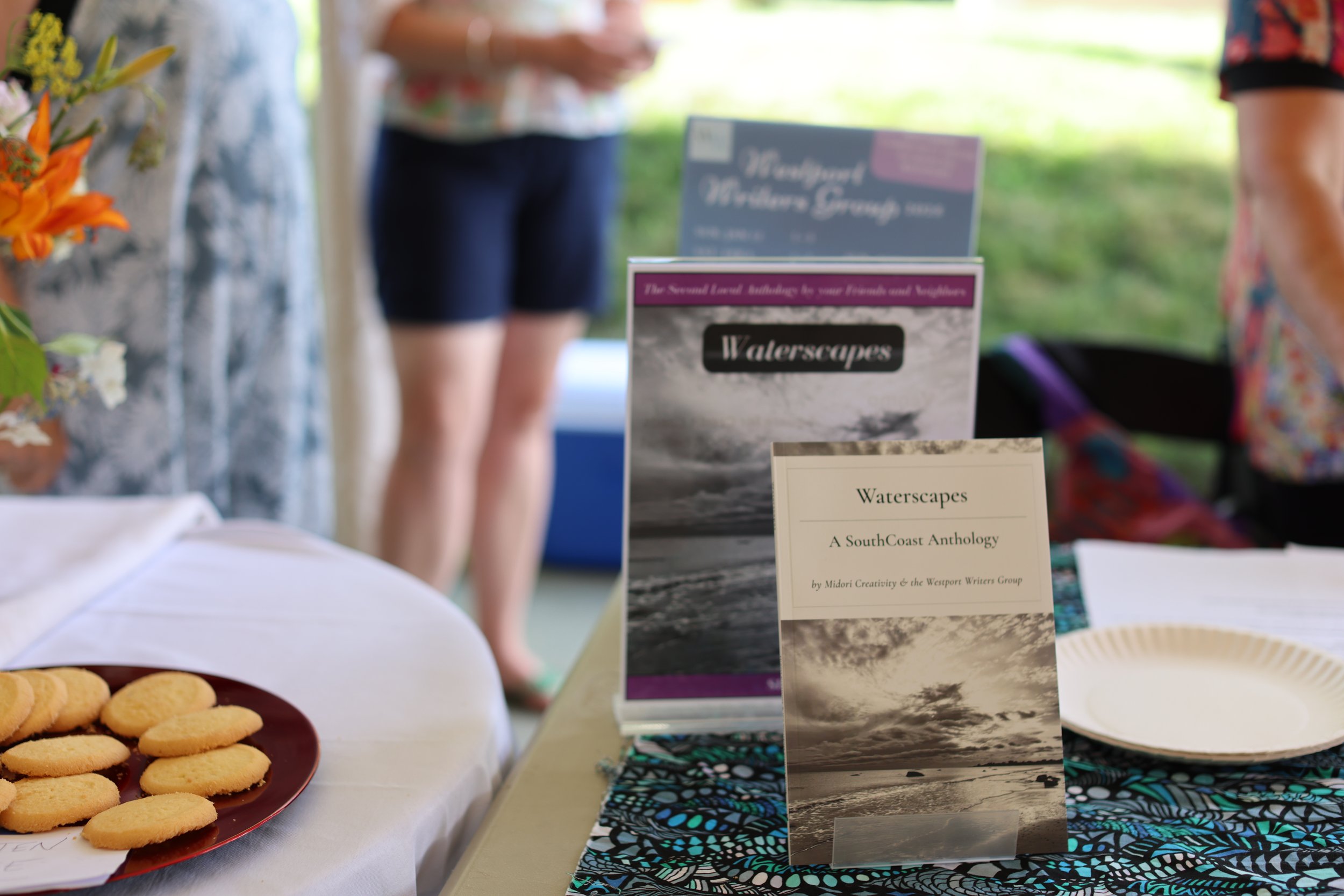
With this experience still fresh in my mind, I look back to a very different type of reading I took part in. On July 18th, the writers of the anthology, Waterscapes, were able to read their works behind the Rotch-Jones-Duff House (RJD), in New Bedford. There was a tent, and the famed rose gardens were surrounding us.
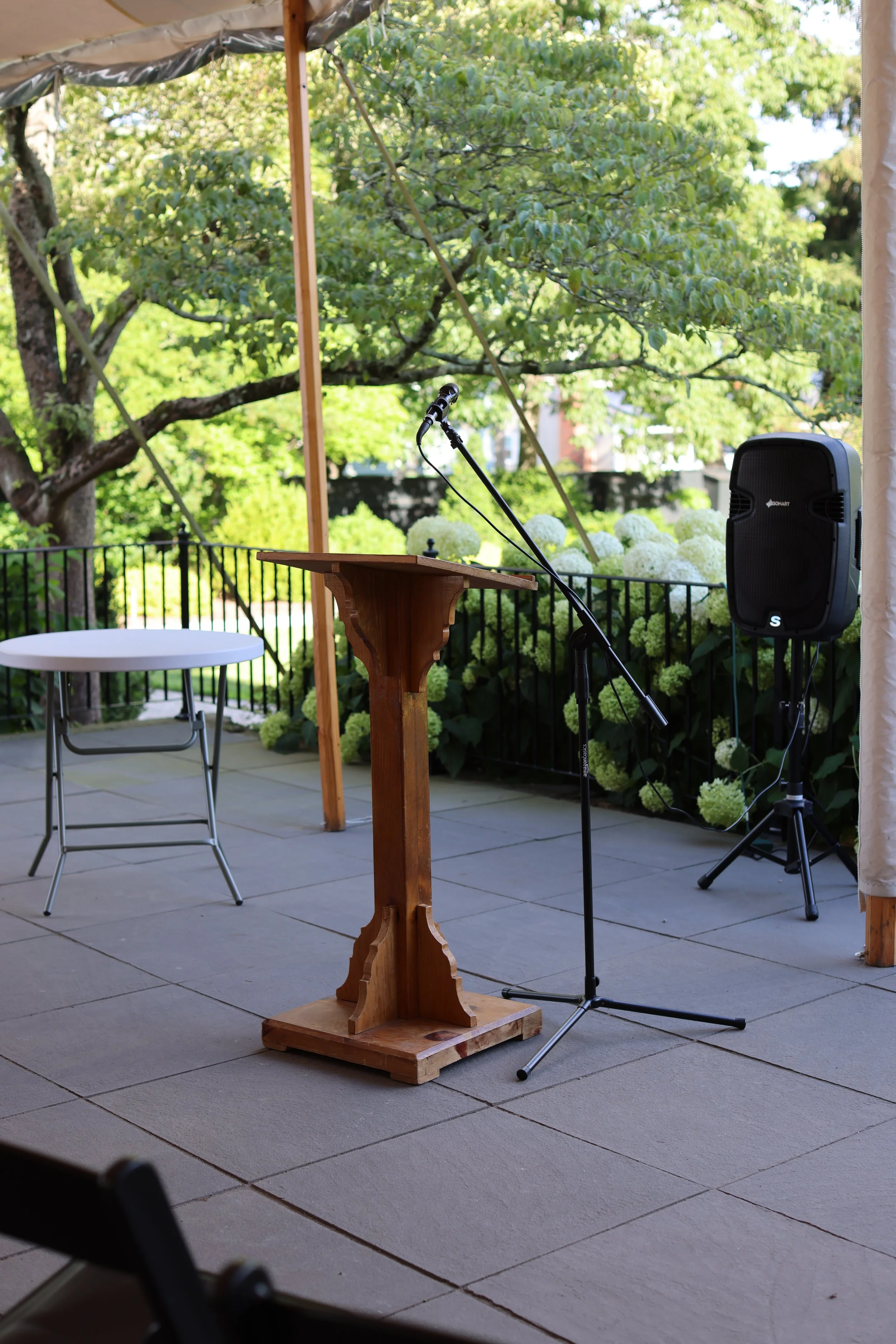
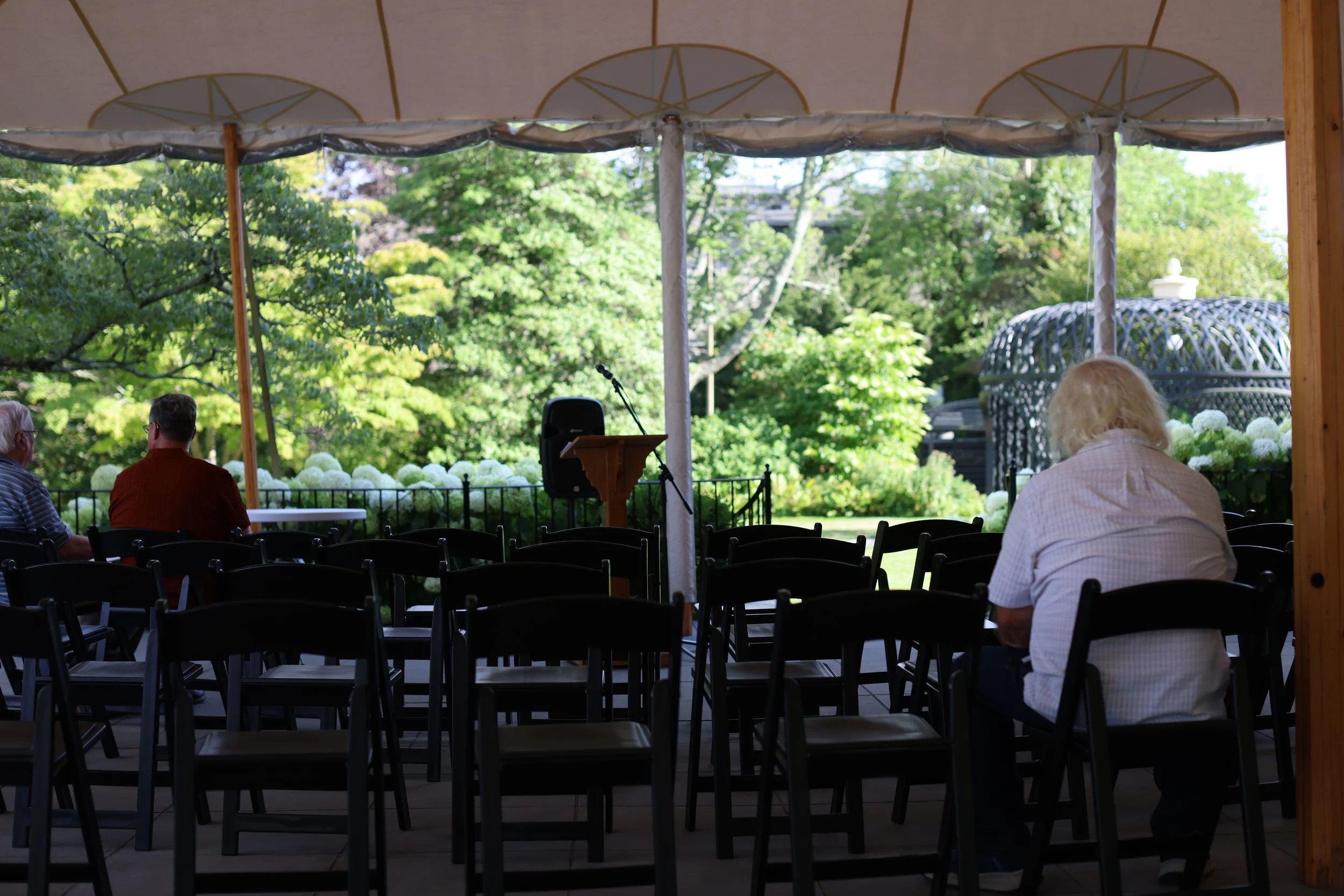
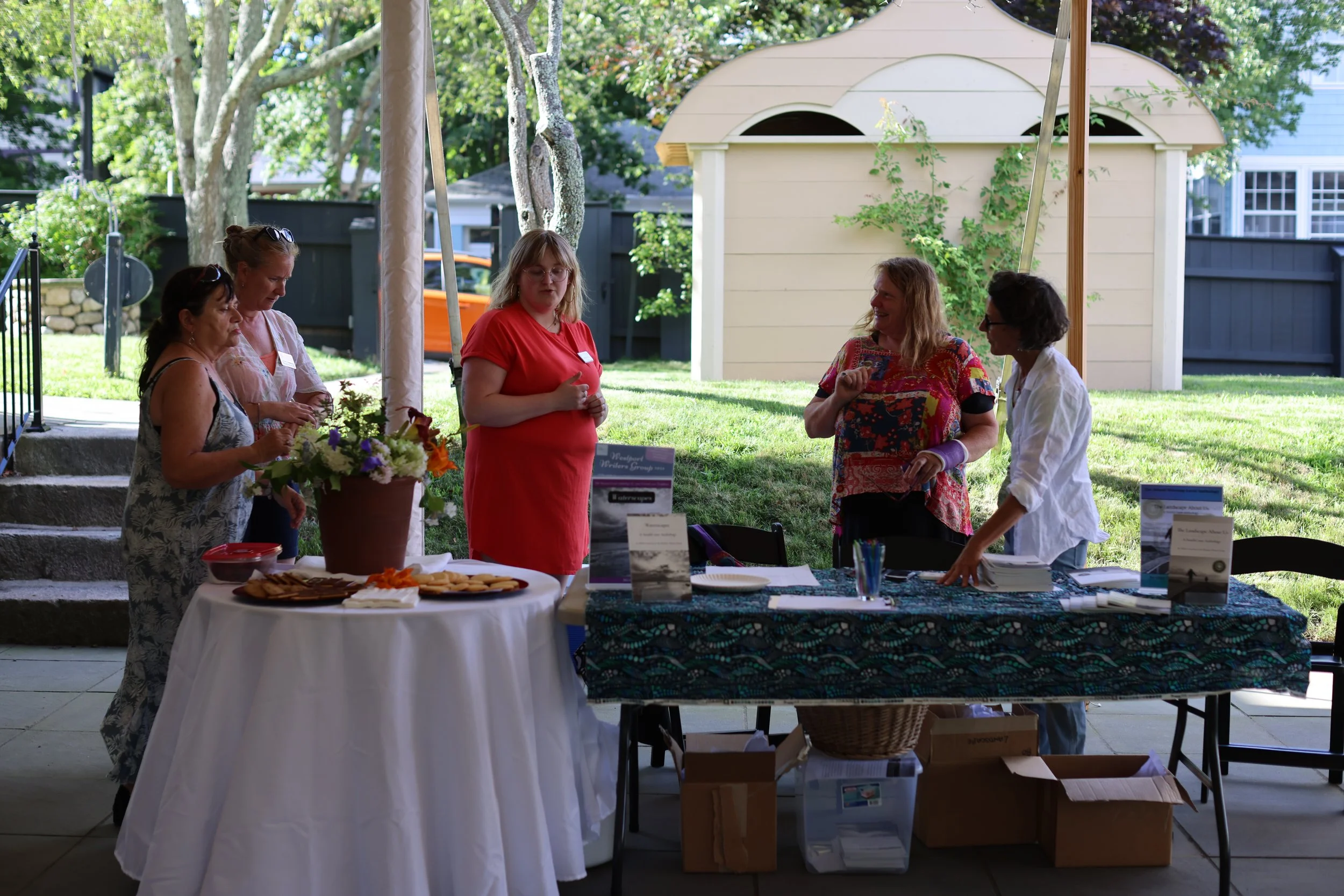
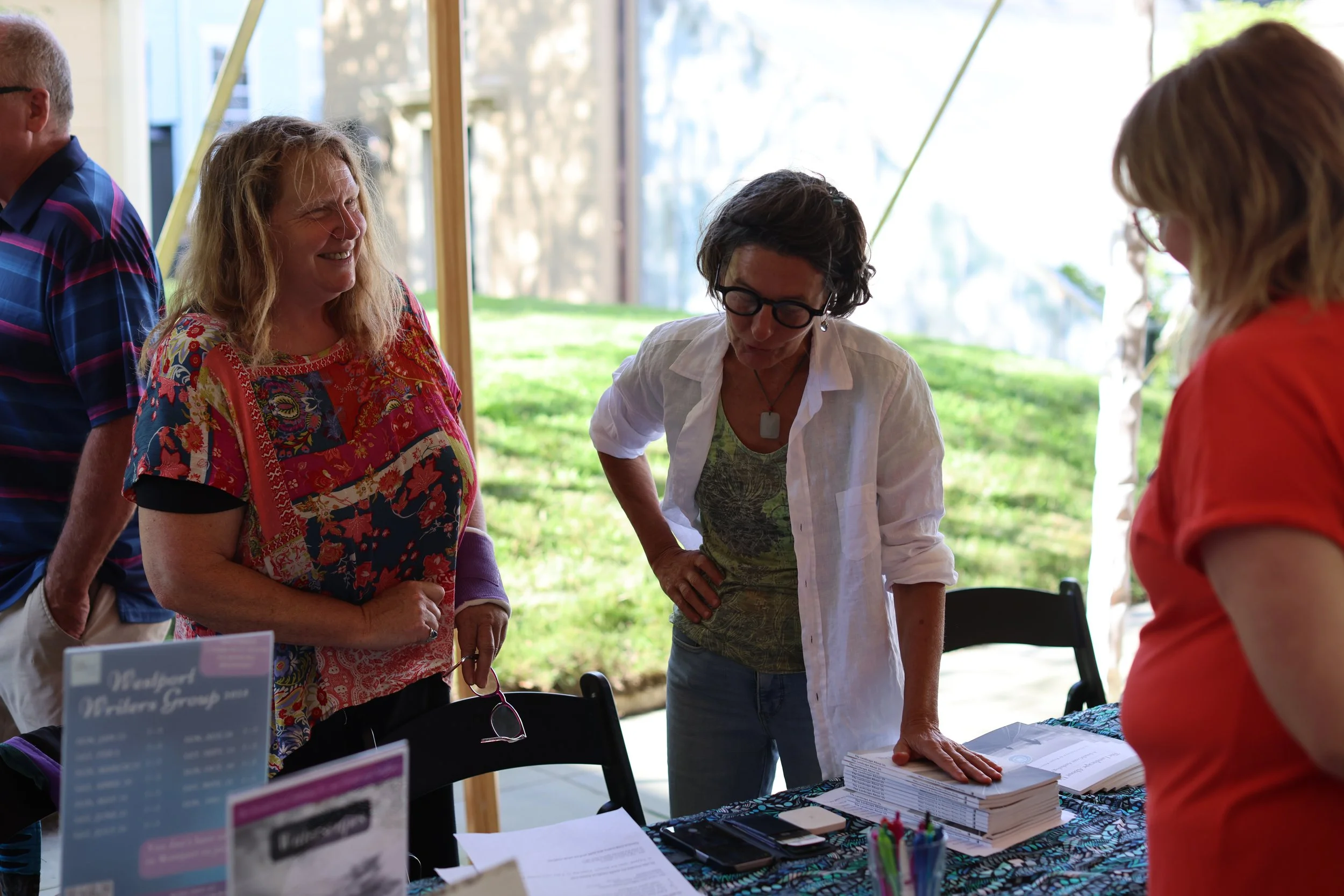
Quickly, what became apparent to me is that the Waterscapes reading felt more like a meditation, mixed with a family potluck. But then these moments hang on in the firmament of my memoryscape, my pages of notes.
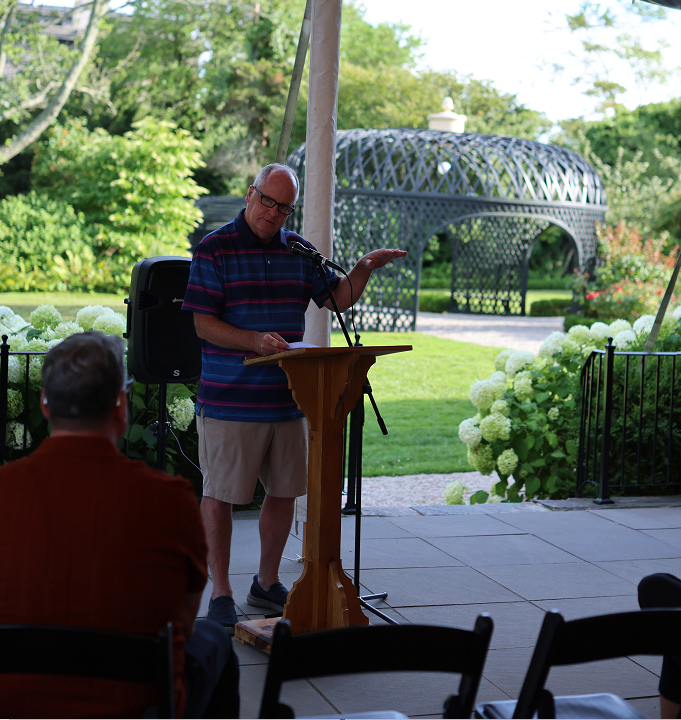
“The wavetops curl and fall as they race to the awaiting shoreline," read Mark Collins, the opening reader, of his piece, “Seaside Experiences on the Wheel of the Year.” His reading cadence was gentle yet as persistent as the ocean waves themselves, lending a calmness to what was a dramatic jumble of words and image.
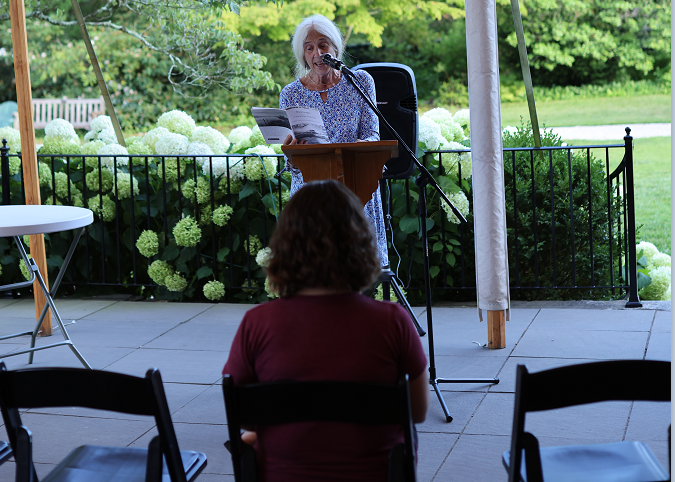
Eve Lesses’ “Glide” was given extra lift from her comments about the importance of the Westport Writers Group to her process. She didn’t belabor or go into more detail, but this washed over me in a way that left me wanting to hear much more about this experience and how it informed her composing of this lush story.
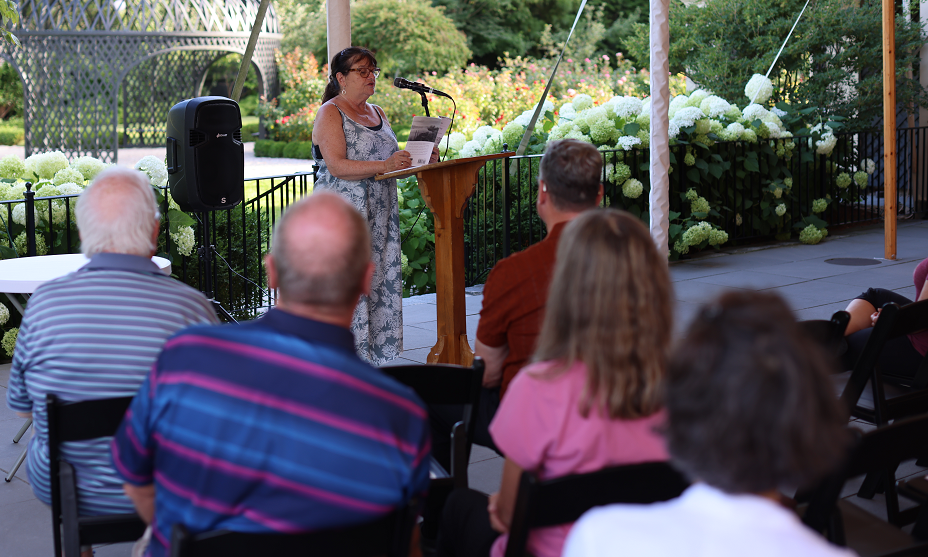
“And then there was the brook, our favorite playground of all,” read Deb Coderre from her piece, “In The Brook,” a line that captures such a human, shared experience that’s hopefully universal.
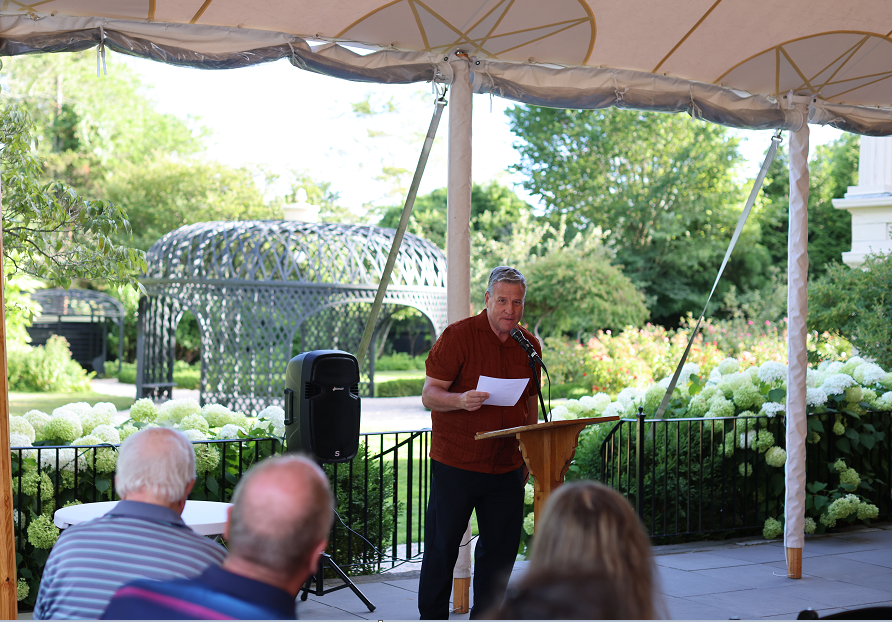
Paul Mercier’s delivery of “Skipping Stones” was given an unexpected edge as he was reading from a single piece of 8.5 x 11 paper.
I imagine with the July heat and humidity, the moisture swelled the fibers a bit, lending a heavier dimple to Paul’s grip amid the white undulated form. This jumped out at me because of the physicality recalled in “Skipping Stones.” Behind him were red roses, perforating the backdrop of green and holding in space and time the very shapes and actions he was reading about. “Ounce for ounce, look hard…unmeasured by distance or skips but time or place…these second chances, these little poems of grace…throw it, throw it, let it fly…” He gestured while reading, and with quick glances from sheet to audience eye, there was a symmetry of delivery and the subject matter. Skip a stone; read a line; repeat.
Kathryn L. Hamilton’s “The Memory of a Ship” made me shed a tear the first time I heard it. Hearing it again—and this is one of the great luxuries of being read aloud to—you pick up on what was missed the first time.
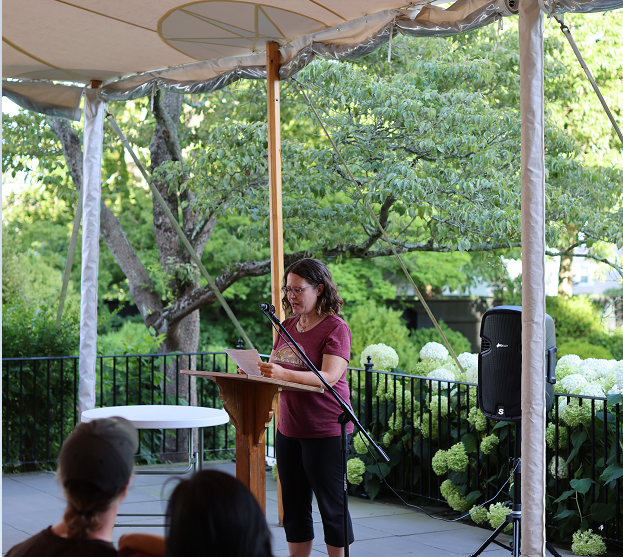
I’ve also heard Krista Allen’s “Hold Down” before, but unlike any of the other pieces, this poem is about near drowning. What’s amazing about it is that Krista is a seasoned surfer who knows the ocean well. While I’ve been in this same situation of being caught under a wave, my experience was much different than Krista’s.
“This is how I’ll die. My lungs will fill with fluid, water, which makes life possible…but not today.” Boom. I think it’s quite possible that she’s gotten philosophical during these exact moments, that she’s experienced this so many times that time slows down, along with her literally having patience during these moments under the wave where she waits until she duck dives or maneuvers out, and in that space, is able to observe and even have a trill of conversation with herself. “But not today.”
I need to ask her if any of this is true!
Another piece I’ve heard before — Midori Evans’ “Rockweed.” Back then, Allen’s Neck Clambake..” was held right at the river. They dig an enormous hole of sand….” Full stop. I hold on to that moment and want to see a photo. I want to ask Midori about Rebecca who is in the story, describing this family tradition. With the previous reading, I held onto something else. And so on and so forth. And then in our interstitial conversations, of plans of attending “the” clambake, the planning, the weather conditions, the particulars and banality exploding against the yawn of history, the story lives in my mind, re-igniting each year, reminding me of the questions I have yet to ask.
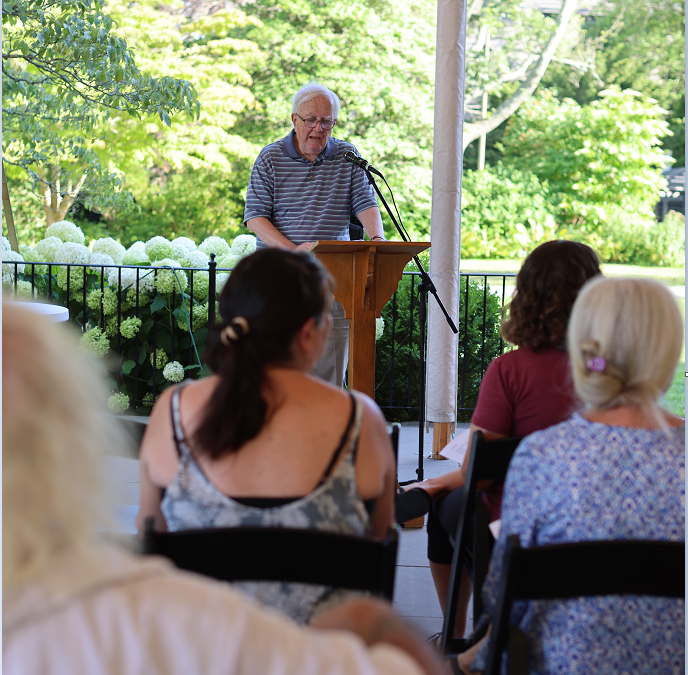
And then there’s Jim, emcee at all the readings. He doesn’t always read his poetry, but this time, he did. James Cronin is his full name. He was once a judge. His poem, “The Water’s Edge,” has never made me shed a tear, but upon the first listening, Jim’s words seized in me something very deep that could only be accessed if by beauty amid refuge, amid safety. Jim starts by telling us about a place he was introduced to by a friend, a place that lay undiscovered by Jim in his 50 years of living in Westport. It was a cow path along the west branch of the river.
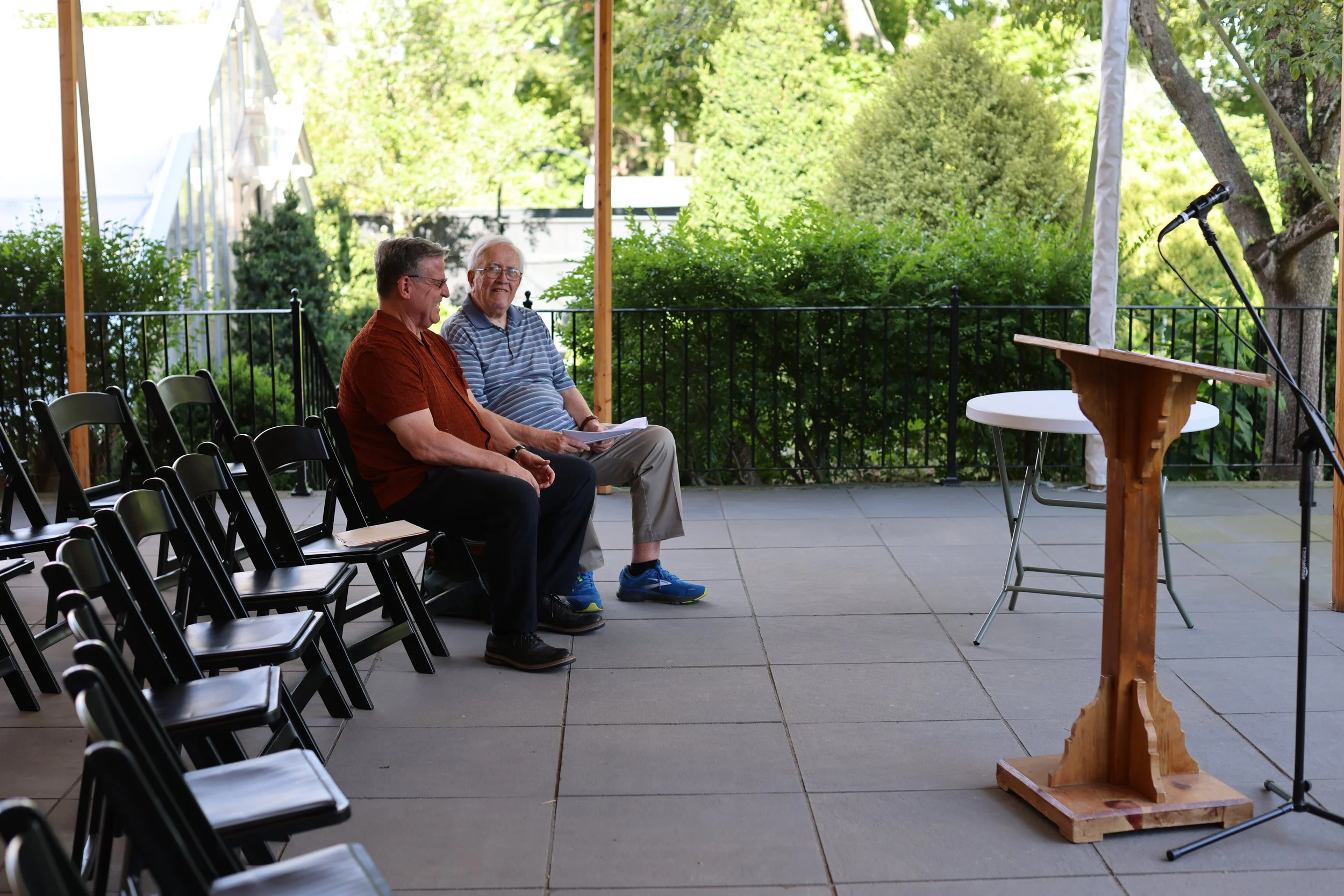
Jim methodically renders the origins of the path, the herding dogs, the salt marsh plants, and then, the low-hanging sun of winter that allows Jim to foreshadow in a way that made people quietly gasp. “This scene and its pledge of ebb and flow is at risk, and my own run faces the implacable subsidence of life.” In what feels like the comfort of history and how things never change, Jim, in the twilight of his own time here, weaves in the environmental crisis.
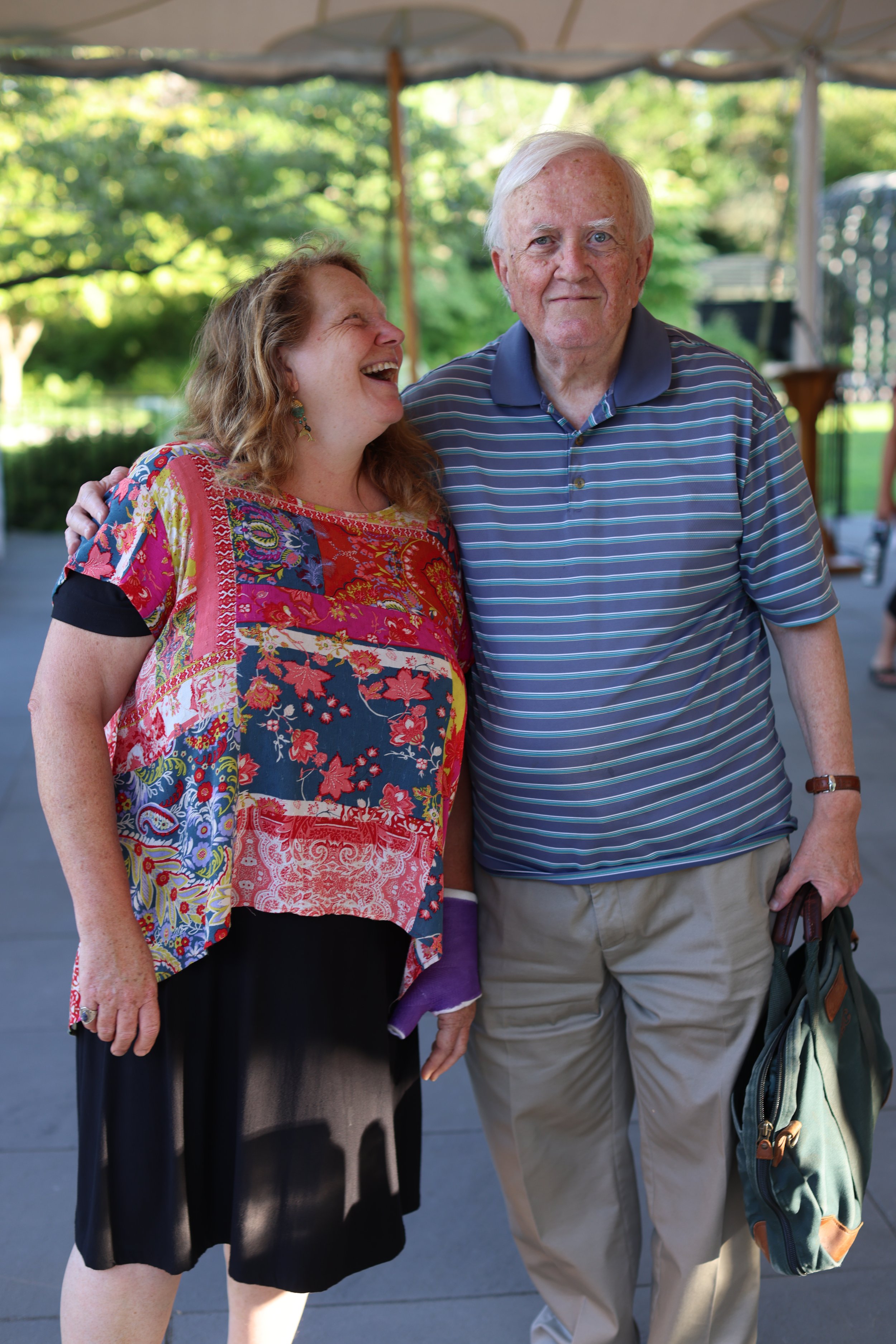
This is the power of the poet, of the writer, of the place, and of the reading. To catch us off guard, to bring to life the print. Anxiety or not, medium be damned—live streaming, in a rose garden—readings are essential. They allow a sensual experience of the text, and this is profound. And for those who are able to catch the clues, who are able to attend to the entirety of the experience, they are always worth it.