Vestibules Project
What does it mean to create art that not only represents environmental issues, but also responds to them in a tangible way? This blog shares the story behind Vestibules, a community-centered eco-art project in New Bedford that brings together public art, ecological restoration, and local storytelling. As the project continues to develop, it has become a space for residents to reflect on their relationships with water, place, memory, and the changing environment around them.
Vestibules: An Eco-Art Installation in New Bedford
In ‘Eco Exhibitions Won’t Save Us’, Marv Recinto concludes that while artworks materialize ideas and educate viewers about ecological degradation, they may not be enough to effect meaningful environmental change. Historian Vid Simonity concludes: ‘The challenge that climate change poses to cultural production, then, is to find those artistic visions that would allow us to keep the disaster fully in view, resist despair and make-believe alike.” How can artworks, he writes, “envision solutions without indulging in a fantasy?’ (2023: 131).
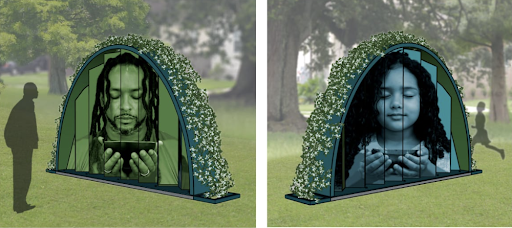
Figure 1: Brendon Palmer Angell, Woven Together concept for Gentilly Resilience District. n.d. Painted Portraits on steel, live jasmine. 7.5 ft x 11 ft x 2 ft. Gentilly Resilience District, Gatto Playground, 1929 Wildair Dr, New Orleans, LA 70122. Courtesy of Brendon Palmer Angell.
Painter Brendon Palmer Angell, whose proposal was also selected by the Arts New Orleans Gentilly Initiative, addresses the water challenges faced by District residents. In his submission, he created a dual portrait (Woven Together): one of a child and the other of an adult. Each figure holds a cup with liquid, suggesting that what we do in the present affects the future. To remind viewers of how enmeshed we are with the biosphere, the artist encases the portraits in a gate-like frame that echoes the water containment vessels buried beneath.
With the eco-art project Vestibules, Katy Rodden Walker and I have attempted to envision such a solution. (we were inspired by eco-art installations in New Orleans, see Fig. 1). Our project, which incorporates community design input, consists of a rain garden that will remediate a waterlogged area in New Bedford’s Brooklawn Park. The garden’s native plants will filter, restore, redirect, and redistribute water and reduce stagnant pools of stormwater runoff that collect after heavy rain flow (a result of climate change, Fig. 2). Over time, visitors will observe the seasonal changes, and the growth, bloom, and decay cycles of the plants that put down roots, as well as the birds, insects, and animals that frequent the space. They will be reminded about how deeply entangled humans are with our aquatic and green natural places.
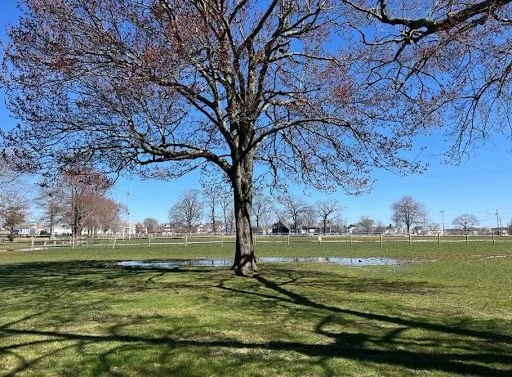
Fig. 2 Katy Rodden Walker, Brooklawn Park: Vestibules Rain Garden Site Location, 2025, Brooklawn Park, New Bedford, MA. Photograph: Courtesy of Katy Rodden Walker.
Vestibules’ Design
Vestibules is an eco-art installation that materializes the connection between the human body’s vestibular system (what supports our corporeal awareness and upright posture) and the “looking glass self”— the “public self” that culture and community shape. Each person’s ear is a gateway (or vestibule) connecting the interior and exterior selves. In the built environments that exist outside the individual, a vestibule also functions as a transitional space between an architectural façade and a structure’s interior.
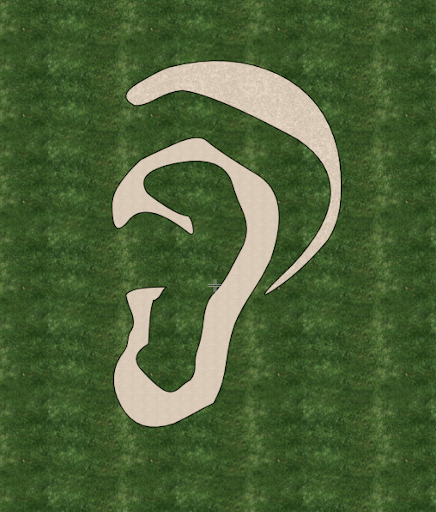
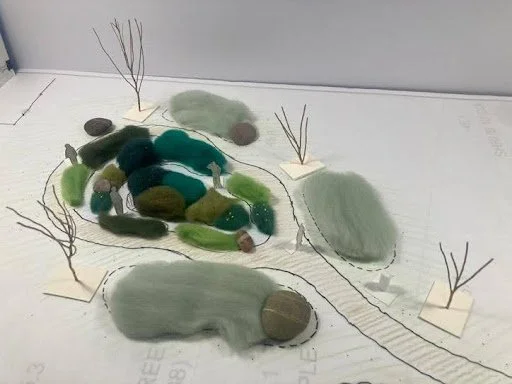
Figure 3: Conceptual Design of Vestibules eco-art garden by Katy Rodden Walker (left) and Hedlund Design Group’s interpretative 3D model of the rain garden (right), 2026. Digital images. Courtesy of Kathryn Rodden Walker and Peter Hedlund.
Vestibules’ conceptual design, an abstracted ear, encapsulates both definitions (Fig. 3). When completed in October 2026, the garden will invite visitors to walk, listen, and reflect on their connections to the natural worlds which surround them. Designed as a living installation, the rain garden will activate a visitor’s primary senses of touch, taste, smell, hearing, and sight – as well as a “sixth” sense: proprioception (awareness of body position and movement associated also with the vestibular sense of spatial orientation). According to Louise Willis, flourishing gardens may “become interactive sites where body, place and substance become enmeshed,” and where, we hope, new stories might emerge that reconfigure long-held narratives, beliefs or conventions – specifically about the human intersection with the non-human environment (Willis 2020: 62).
The garden, which is approximately eight hundred square feet, will consist of native plants, walkways, and a grass perimeter (Fig. 3). We have selected native plants that will slow down, absorb, and remediate standing water that lingers longer than twenty-four hours: including perennials such as sedges, ferns, and butterfly weeds. Visitors will learn about these resilient plants—species which thrived hundred years ago, and can still flourish today, if we nurture and care for them.
From the parking lot, visitors will walk along a crushed seashell path that directly leads to the garden. The seashells contain calcium carbonate, a chemical compound that is also a component of crystals in the inner ear. On the one hand, these crushed, organic forms link Vestibules biological and architectural design concepts. On the other, the seashell walkway serves a remediating function. It allows water to pass through to the ground below, connecting the rainwater to the brooks that flow beneath the surface.
While the path represents an obvious visual marker, the three art installations which sit just outside the garden’s boundary will also draw the pedestrian’s ‘eye’. These works, which function as beacons, call out to potential visitors about the garden’s presence. According to philosopher Martin Heidegger, “A boundary is not that at which something stops, but as the Greeks recognized, the boundary is that from which something begins its ‘presencing’.” (1971: 154). Though the installations will invite visitors to draw near and immerse themselves inside and be “present” within the garden’s sensually evocative world. But their grounded visibility among the mowed green lawns also call attention to the natural world we have attempted to control.
Vestibules, Stories and Community
Currently, we are about sixty percent through this project. Construction and planting will commence in September 2026. Katy and I have held several events to solicit community input about this working design. At them,, we have gathered individual stories that reflect New Bedford’s residents’ current attachments to and historic memories of the city’s natural places—stories that will shape the art installations that frame the garden’s perimeter.
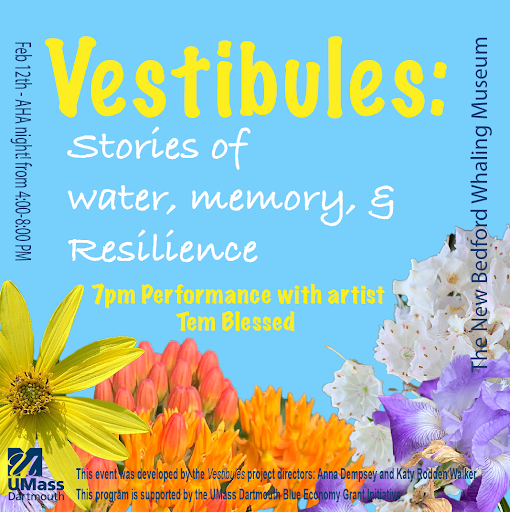
Recently, we collaborated with Tem Blessed, a Cape Verdean musician, storyteller, and graphic novelist, with over twenty years of experience as a climate and community activist. Blessed creates works to empower, uplift, and inspire collective action. With the Vestibules team, he co-emceed a free and interactive storytelling event at The New Bedford Whaling Museum, titled “Vestibules: Stories of Water, Memory, and Resilience.” (Fig. 4).
With Blessed, visitors recorded stories or poetry about their personal and ancestral connections to water and to place. Beatriz Oliviera, a New Bedford resident who emigrated from Portugal in 1980, recorded the following: “the sea is both mother and dare.” (Fig. 5). The Atlantic Ocean “moves between my two homes,” occasionally spraying its mist across New Bedford’s cobblestones, where she now resides. The Atlantic, in other words, connects Oliviera’s past to the present – forming a bridge between her two homes.
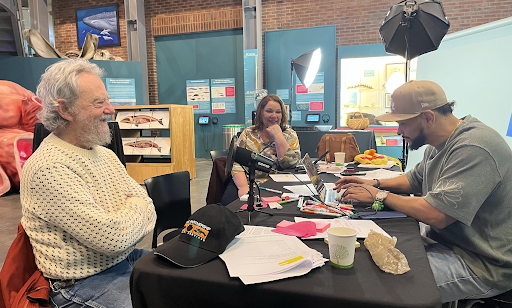
Figure 5: Tem Blessed (right) recording participants’ oral histories at Vestibules: Stories of Water, Memory, and Resilience. New Bedford Whaling Museum, New Bedford, MA. 12 February 2026. Photograph: Courtesy of Katy Rodden Walker.
Iva Brito, New Bedford native and award-winning poet, recorded a poem she had spontaneously written at the event, titled Water:
Water is home.
Water is the journey of remembering.
Remember. Remember. Remember its power - able to transform
Remember its joy - bringing in childhood memories
Rain dances in my native land of Cape Verde
Celebrating its presence - please stay, please don’t go - extending its invitation home.
Water is remembering its integration with the sunsets - the sky against West Beach - as it massages the stresses of the day away.
Water is gathering.
Water is holding still - to the potential - to the power - to the knowing that water will always transform.
Water is home.
(Brito: 2026)
During this event, writers from the nearby Westport Writers Group encouraged visitors to write down their reflections about New Bedford’s present and historic ties to water. In a conversation with me, Deborah Coderre recalled the arbor vine pavilions that were situated in numerous New Bedford backyards. For many residents, whose ancestors traveled from the Azores, the vine-covered pavilion framed a place that referenced the saltwater-sprayed vineyards of their volcanic island homes. As material symbols, the living vines bridged the distance – in time and space – between both sides of the Atlantic world.
From these stories, Katy and I will develop themes and a creative framework that will shape the creative garden installations. For Vestibules to succeed, however, each of the selected works must function in dialogue with the rain garden—a vital yet contemplative space that enfolds visitors within the natural world.
Conclusion
Within a broader context of art and the urban landscape, ecocritical art shifts an artwork’s function from that of a contemplative finished product to a process-oriented community engagement with the natural world. With Vestibules, Katy Rodden Walker and I have sought to remediate environmental problems (or intervene before they occur) through an active collaboration with nature, artists and community. When Vestibules is completed, residents will have access to natural resources, shaded areas, a communal gathering space, a living art installation, and educational materials for generations to come.